QRYPTA Documentation
Deep technical insights into the infrastructure powering post-quantum, privacy-preserving, AI-enhanced digital finance.
QRYPTA® token & contracts
Official addresses, 0.1 % burn, how to buy.
Staking & referrals
90/180/240 terms, multipliers, on-chain referrals.
Cryptographic suite
ML-DSA-44 · ZK-STARK · ML-KEM · SLH-DSA · AEAD
Technology stack
Token, wallet, staking and NEUROCHAIN: spec sheet.
NEUROCHAIN
Post-quantum, AI-native Layer 1 · 2027.
Roadmap & company
Phases, milestones and legal data of Provident Quantum Tech.
ISO 20022
Financial standard bridging banks & Web3.
Post-Quantum Security
NIST-approved algorithms protecting assets.
Wallet Architecture
Smart accounts overriding seed-phrase vulnerability.
AI Systems
Intelligent autonomous operations.
Infrastructure
The core architecture ecosystem.
Educational Guide for the Community
This document explains, clearly and without excessive technicalities, what ISO 20022 is, why it matters, and how QRYPTA integrates it into its token and wallet to bridge Web3 with the global financial system's language.
1) What is ISO 20022?
ISO 20022 is an international standard created so that financial institutions "speak the same language" when exchanging data. It defines how payment information, transfers, and reports must be structured so different systems understand it consistently.
It doesn't just send messages; it sends messages with rich context. Instead of just sending an amount and destination, it includes structured data about the originator, beneficiary, purpose, and compliance. The ECB highlights that ISO 20022 allows the use of enriched data elements that don't fit in legacy formats.
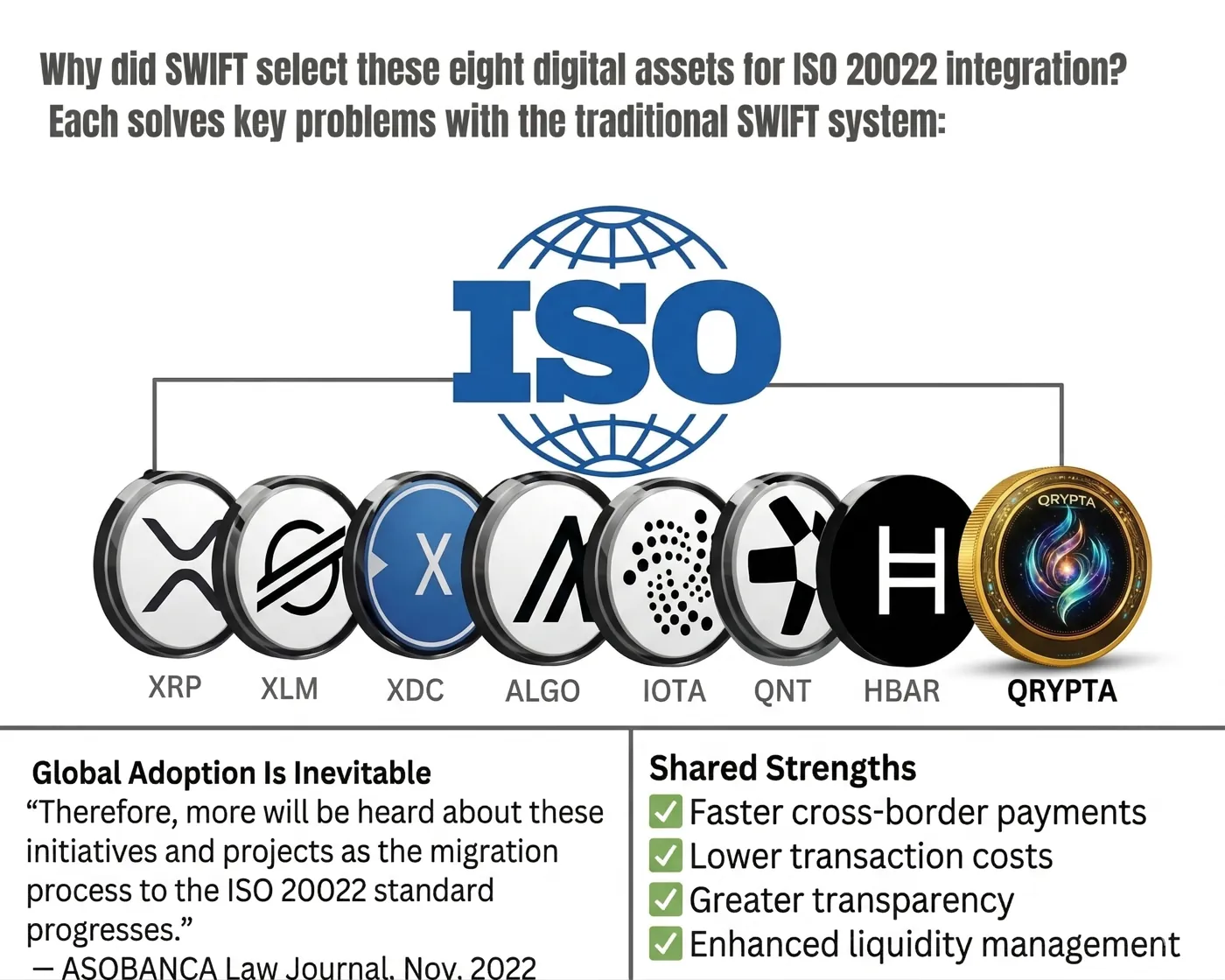
2) Why is the financial world migrating?
Legacy formats work, but they fall short for a global financial system demanding interoperability, automation, and traceability. SWIFT describes ISO 20022 as the global standard for cross-border payments. In the US, the Federal Reserve implemented it in Fedwire in July 2025.
Translated to plain English: banks are modernizing how they process payments. If Web3 wants to connect with banks, fintechs, and treasuries seriously, it needs to integrate with that language. This is where QRYPTA gains a strategic advantage.
- No structure
- No banking compatibility
- Isolated systems
- Structured data
- Interoperable
- Institutional-ready
3) What does ISO 20022 mean for QRYPTA?
For QRYPTA, ISO 20022 is not "putting a banking label on a token", but building an interoperability layer. The token and wallet handle data and flows compatible with the modern financial system. This doesn't replace Ethereum or BNB Chain; it makes them easier to connect with institutional contexts.
QRYPTA uses ERC-20 on Ethereum and BEP-20 on BNB Chain for on-chain life, while adding a complementary layer of metadata, messaging, and semantic compatibility inspired by ISO 20022 for off-chain life. They do not compete; they fulfill different functions.
4) Token Integration with ISO 20022
Product integration operates across key functional layers:
1. Structured references: Each operation carries normalized fields (purpose, commercial ID, category) facilitating auditing.
2. Event mapping: On-chain events map to semantic representations that the financial world already understands.
3. Treasury compatibility: ISO-friendly metadata reduces friction between Web3 logic and corporate back-office operations.
4. Tokenization support: Bridges blockchains with traditional finance, aligning with SWIFT's push for interoperable digital assets.
5) Wallet Integration with ISO 20022
The token is the asset; the wallet is the experience. The most powerful integration with ISO 20022 lives in the wallet. It converts technical language into clear financial language. Instead of showing just hashes and gas, it shows categories like "payment", "international transfer", or "settlement".
Wallet + Account Abstraction (ERC-4337): This enables programmable wallets without changing Ethereum's consensus. The wallet can apply logic, limits, corporate workflows, and extra security. ISO 20022 provides semantic clarity, while ERC-4337 provides operational capacity.
6) Why Ethereum and BNB Chain?
They already have enormous ecosystems, liquidity, tooling, and EVM compatibility. Deploying on them avoids creating a new Layer 1 from scratch. BNB and ETH provide distribution; ISO 20022 provides financial language; QRYPTA provides the connective layer.
7) Institutional Adoption Profiles
Most likely adoption profiles include Commercial Banks (seeking bridges for international flows), Fintechs (needing rich interoperable data structures), Corporate Treasuries, and Institutions exploring tokenization (like those piloting interoperability with SWIFT).
Official Stance: QRYPTA is designed to be compatible with the direction the global financial infrastructure is taking: more interoperability, structured data, and connection between digital assets and institutional systems.
8) Long-Term Projection
ISO 20022 gives QRYPTA three advantages: Institutional relevance (speaking the operational language), better positioning in tokenized assets, and superior UX for mass adoption.
9) What it means for everyday users
Clearer transactions (understanding what happened), less confusion between crypto and traditional finance, and higher trust. It feels less like an experimental tool and more like serious financial infrastructure.
Conclusion
QRYPTA doesn't use ISO 20022 to look like a traditional bank. It uses it to make digital assets converse with the financial infrastructure the world is already adopting. Our goal is to combine Web3's flexibility with the clarity and institutional readiness demanded by the next era of digital finance.
Quantum computers
Why quantum computing matters, the risks it creates, and how QRYPTA prepares for that future.
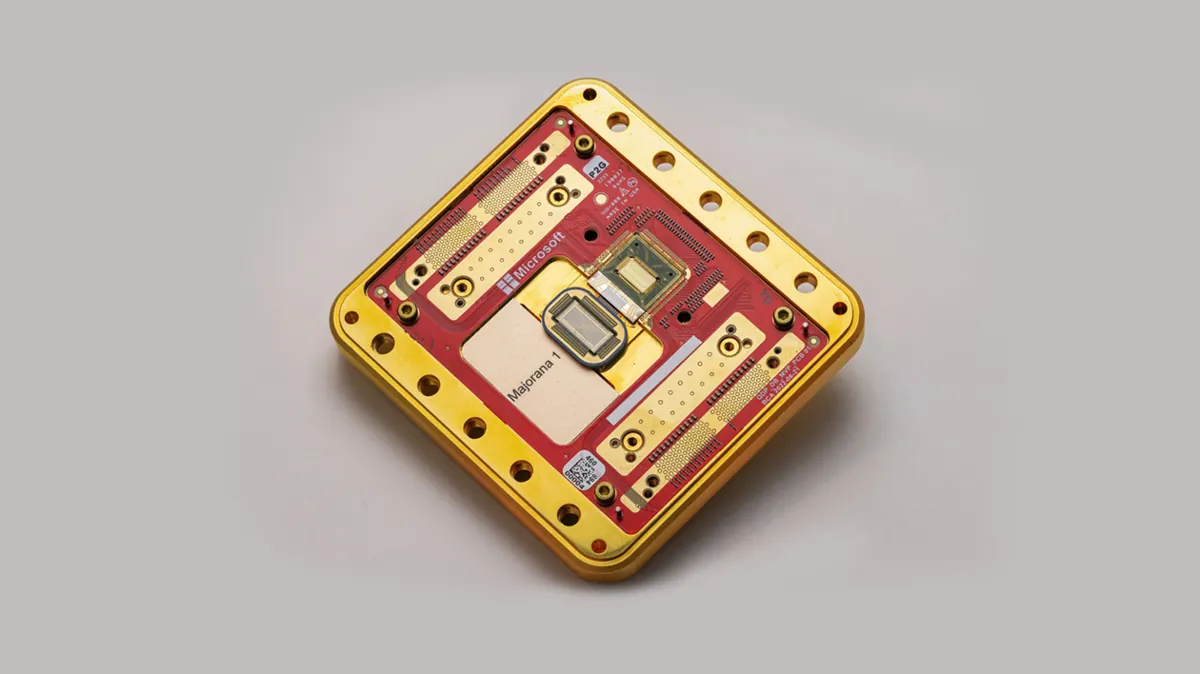
1) What is a quantum computer?
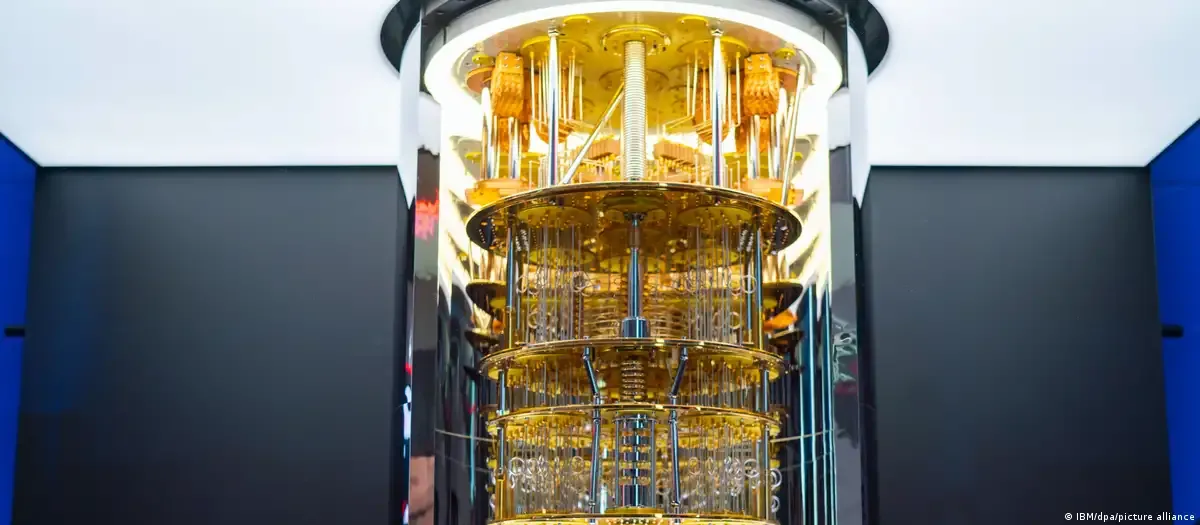
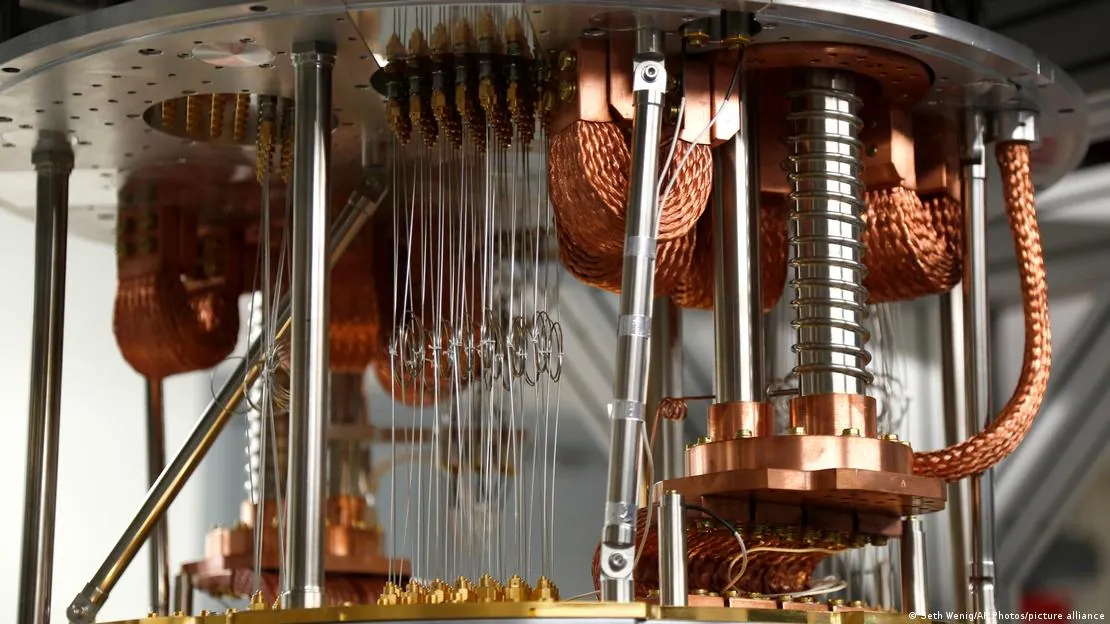
A machine using quantum mechanics to process information differently. While traditional computers use 0s and 1s, quantum computers use qubits. Google and IBM are actively scaling logical, error-corrected qubits. They can solve specific mathematical problems that currently sustain modern public-key cryptography.
2) Development status
A cryptanalytically relevant quantum computer capable of breaking real-world RSA or ECC does not exist yet. NIST says it could be "years or decades" away, but urges migration because the impact would be systemic. IBM targets 200 logical qubits by 2029. We are not at Q-Day yet, but standard agencies are acting as if migration must start now.
3) When could global cryptography break?
There is no single accepted date. NIST notes that some believe it could happen in less than 5 years. The Global Risk Institute concludes it is "probable" within the next 10 years. NIST published its first PQC standards in 2024, aiming to retire vulnerable algorithms by 2030.
4) Not just a blockchain threat
It affects systems protecting certificates, firmware, browsers, cloud infrastructure, and traditional banking. The NSA has set immediate transition milestones for national systems. It is a global cybersecurity transition.
5) Why is blockchain exposed?
Ethereum and EVM ecosystems rely on public-key cryptography. Accounts use private keys (secp256k1/ECDSA) to prove ownership. If a capable quantum computer attacks ECC efficiently, EVs account control and signatures would be exposed.
6) The most misunderstood risk: "Harvest now, decrypt later"
An attacker can collect encrypted data today and save it to decrypt it in the future when quantum capacity exists. On blockchain, transactions are public, making "harvest now, decrypt later" critical for off-chain elements: encrypted messages, wallet backups, recovery materials, and private operative metadata.
7) How does QRYPTA fit into EVM Networks?
QRYPTA acts as an advanced post-quantum security layer over EVM networks (BNB Chain, Ethereum, and Core DAO) without requiring a new Layer 1 migration. The base network provides core execution and liquidity, while QRYPTA secures the user layer (wallets and smart accounts) using the ZK + ML-DSA-44 framework.
8) Detailed ZK + ML-DSA-44 Architecture
The ZK + ML-DSA-44 framework provides absolute post-quantum security with extreme EVM efficiency on multiple chains including BNB Chain and Core DAO. The operational pipeline consists of three fundamental layers: 1. Off-Chain Signature Generation: The user signs the financial transaction using their private key under the FIPS 204 ML-DSA-44 standard. This lattice-based scheme (specifically Dilithium2 parameterization) is mathematically proven to be immune to Shor's algorithm and quantum cryptanalysis. However, an raw ML-DSA-44 signature is large (approx. 2.4 KB) and on-chain verification in EVM would consume over 1.8 million gas, exceeding block limits. 2. Off-Chain ZK Proof Compression: To bypass the EVM gas bottleneck, Qrypta uses an off-chain Prover. The prover runs our post-quantum zk-STARK circuit which takes the ML-DSA-44 public key, the message, the signature, and the user's registered PQC Root. It verifies the lattice signature mathematically and generates a highly compressed, zero-knowledge Binius proof. This proof attests to the signature's validity without revealing the public key, reducing a 2.4 KB signature to a lightweight cryptographic proof. 3. On-Chain Solidity Verification: The compressed proof is submitted to the Qrypta Multi-Chain Token Contract. The contract forwards the proof, along with the program's unique Verification Key (vKey), to our optimized SP1 Verifier Gateway. The gateway executes a transparent, zero-knowledge verification in under 260,000 gas, checking that the proof is cryptographically sound and matches the user's registered public key root. Once verified, the transaction executes securely, offering total post-quantum protection at standard EVM transaction fees.
10) Why is QRYPTA more secure against attacks?
It reduces reliance on a single point of failure (a single private key). QRYPTA transforms the account into a programmable security system with multi-validations, daily limits, and progressive post-quantum extensions.
11) Privacy layer
Reducing metadata exposure and adding encryption layers for recovery means the user reveals less useful information for future data-harvesting attacks.
12) Real-World Verified Genesis and On-Chain Contracts
Our ZK + ML-DSA-44 post-quantum infrastructure is fully operational on production networks. All contracts are verified and identical multi-chain Token Contracts are active under the same address: 0x5266fe1aD9B035d0ED6142f1A70e9D6F102c8153 across Ethereum Mainnet, BNB Chain, and Core DAO. The verified on-chain deployments and real production transactions are documented below: • Core DAO (Core Chain): - Identical Token Contract: 0x5266fe1aD9B035d0ED6142f1A70e9D6F102c8153 - SP1 Verifier Gateway: 0x0ADF535F0dFc9D702Ad3Fb0ad745c1cb08697388 - Core DAO Binius Verifier: 0x31A9b212833bDC77a7cEDb484636607961C4529f - Verified ZK-Proof Verification Tx: 0x87354a7349586826dd3ff17ba11582b06d5b246b5832f5c4b368a52755a877ee (Accepts the cryptographic proof using Binius matching logic successfully) • BNB Chain (BSC): - Identical Token Contract: 0x5266fe1aD9B035d0ED6142f1A70e9D6F102c8153 - SP1 Verifier Gateway: 0x0ADF535F0dFc9D702Ad3Fb0ad745c1cb08697388 - BSC Binius Verifier: 0x7C81378458B0a9E9f09aD74F127eEED97293D01A - Verified ZK-Proof Verification Tx: 0xcb04fefc37404d727e4078de1834de2594820e6ffa64fcb3d78d970cb91a789f - Verified Genesis Transaction: 0x16984fc90a7de3231fff33db63420031ce26557b807415cdba0086cdcc7178aa • Ethereum Mainnet: - Identical Token Contract: 0x5266fe1aD9B035d0ED6142f1A70e9D6F102c8153 - Verified ZK-Proof Verification Tx: 0x60022ac15de25d3df59f9c569dea69a04aa36eaffc6f41b44a3b506d4f273a57 - Verified Genesis Transaction: 0xf40b3665f19c9d1df309d203e2026f280d617fc6d1488763040c045de141a259 These verified records represent the world's first production-grade post-quantum zero-knowledge payments in action.
.jpg)
Conclusion
Quantum computing hasn't broken global cryptography yet, but the migration has started. QRYPTA doesn't replace Ethereum; it hardens the layer where user security truly lives. Our goal is to make the next generation of wallets resistant to the risks of the coming decade.
The future of wallets: programmable, secure, and frictionless
ERC-4337 is an Ethereum standard introducing Account Abstraction without changing the base protocol. Simply put: it turns wallets into programmable smart accounts instead of simple addresses controlled by a private key.
1) What is ERC-4337?
Traditional wallets: one private key controls everything, a signature authorizes all actions. With ERC-4337: the wallet is a smart contract, security logic is programmable, authorization is much more advanced.
Account
2) Where is it working today?
ERC-4337 is active in the Ethereum ecosystem (mainnet, Arbitrum, Optimism, Base) powering apps that use smart wallets. Real examples include wallets with social recovery, gas abstraction, and flexible signature systems. It is not theory; it is a functional Web3 layer.
3) Why is it so important?
ERC-4337 addresses a major Web3 problem: current wallets are too fragile and hard to use. Losing the seed phrase means losing funds, new users face complex experiences, and there are no real recovery mechanisms. ERC-4337 completely changes this model.
4) What does ERC-4337 enable?
1. Programmable wallets: Accounts become logical systems with spending limits, multi-validations, and custom rules.
2. Gas abstraction: Users don't need ETH/BNB to pay fees. Another entity can sponsor gas, offering a Web2-like experience.
3. Social recovery: Account recovery without relying solely on a seed phrase (guardians, multi-factor, distributed recovery).
4. Batch transactions: Multiple actions in a single operation, reducing friction and improving UX.
5. Custom signature logic: Not limited to classic signatures. Supports advanced validation and serves as the foundation for post-quantum integration. (Critical for QRYPTA).
5) How does it improve security?
Before: Security = a private key. Now: Security = a programmable system. This eliminates the single point of failure and allows defining authorization rules.
6) What it means for everyday users
ERC-4337 makes wallets feel like modern apps, not technical tools. Users don't need to understand gas, they can recover accounts, and transact without constant fear. It makes Web3 usable at mass scale.
7) QRYPTA's role within ERC-4337
ERC-4337 is the foundation. QRYPTA is the evolution built on top of that foundation.
8) What does QRYPTA build on top?
- 1. Multi-layer security: Moving beyond single signatures to include dynamic policies and risk control.
- 2. Post-quantum readiness: Leveraging custom signature logic to integrate quantum-resistant schemes and evolve the model without altering the network.
- 3. Intelligent accounts: The wallet interprets and decides via behavioral analysis, suspicious activity detection, and user assistance.
- 4. Compromised seed protection: The seed is not the sole factor. Additional rules and pre-execution validations mean that an attacker obtaining the key does not automatically steal the funds.
- Programmable validation
- Multi-layer security
- Authorization logic
- Post-quantum integration
- Intelligent assistance
10) Why is this key for the future?
The future of Web3 relies on better security and better experience. ERC-4337 is the step towards that. QRYPTA builds on top of that step.
11) Strategic Positioning
ERC-4337 transforms wallets into programmable systems. QRYPTA utilizes that capability to construct a new generation of security, privacy, and user experience in Web3.
Qrypta Artificial Intelligence Ecosystem
This section details the architecture, functionality, and competitive advantages of our wallet's two pillars: the Integrated AI Agent and the Predictive Autotrading Module.
I. The Native AI Agent (The On-Chain Orchestrator)
Qrypta's AI Agent is not a cosmetic chatbot; it is an Account Abstraction layer powered by Large Language Models (LLMs) optimized for Web3.
How does it work technically?
The agent operates under an Intent-based Execution model.
Data Capture:
Receives commands via voice or text. Uses a Natural Language Processing (NLP) engine to extract variables: Asset, Amount, Action, and Condition.
Market Contextualization:
Before executing, the AI queries price oracles (like Chainlink or Pyth) and scans the Order Book of major DEXs.
Payload Generation:
The AI builds the technical transaction (blockchain code) and presents it humanly so you only have to sign with your fingerprint or FaceID.
Security: Why 'inside' the wallet?
The AI lives in a layer above private keys. It can propose a transaction, but it can never sign it. Cryptographic control remains 100% with the user (Self-Custody).
Before interacting with a suspicious dApp, the agent simulates the transaction in an isolated environment. If it detects a drain function or a malicious contract, it blocks the action and explains the risk in plain language.
We aim for most personal data processing to occur locally on the device, minimizing the exposure of your investment strategies on external servers.
II. Predictive Autotrading Module (Quantum-Ready Bot)
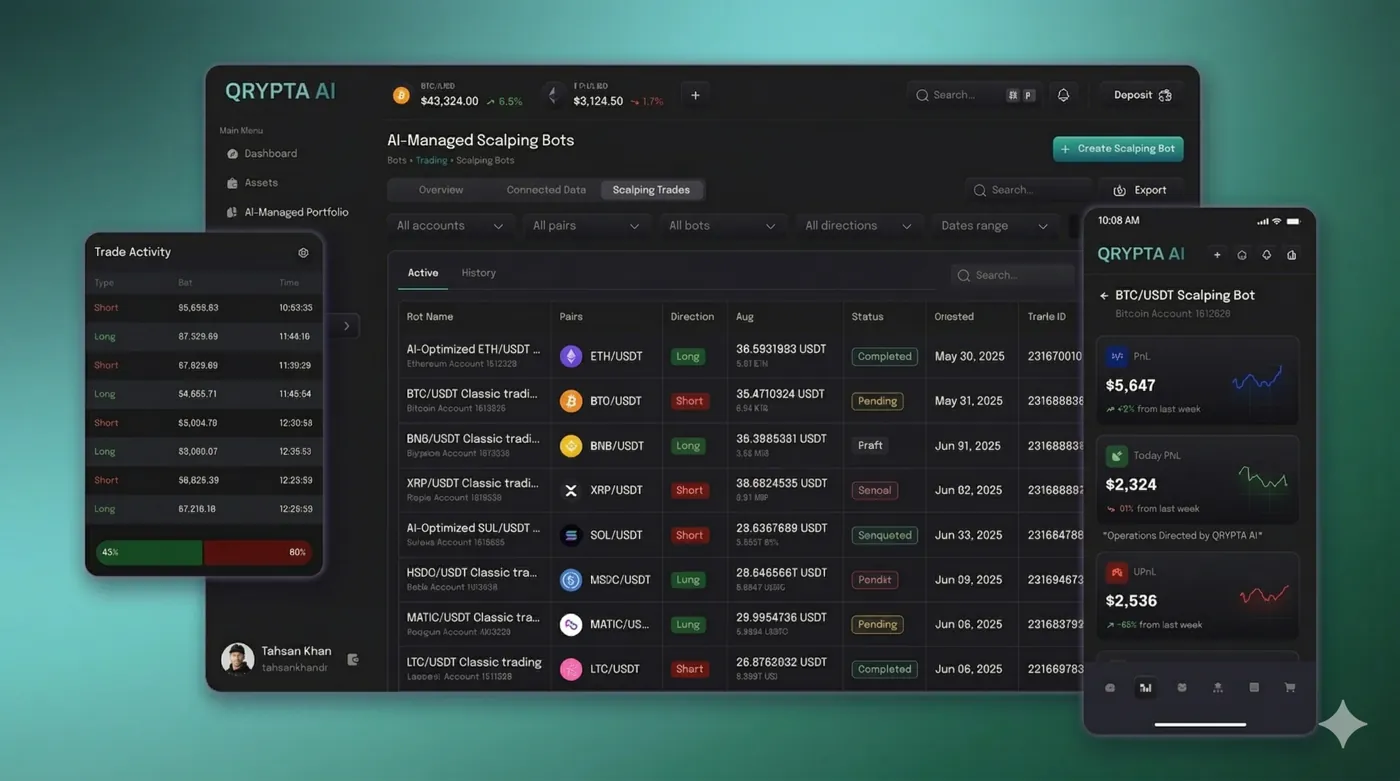
The Autotrading module is a high-frequency execution engine designed to democratize strategies previously only available to Hedge Funds.
Algorithm Functionality
Unlike standard Grid or DCA bots, our bot utilizes Reinforcement Learning Models:
- Sentiment Analysis:
Processes news from global APIs and social media in milliseconds to anticipate volatility movements before they hit the charts.
- Liquidity Detection:
Identifies liquidity 'gaps' in the market to execute large orders without suffering slippage (value loss due to lack of buyers/sellers).
Why is it innovative compared to BNB and ETH?
On networks like Ethereum (ETH) or BNB Chain, trading is often reactive and costly due to 'Gas'. Our module introduces:
The bot can pay fees via the same token you are trading, eliminating the need to always hold ETH or BNB in reserve.
On ETH, other users' bots often 'steal' your price (front-running). Our module uses private sending routes (like Flashbots) making your operations invisible until confirmed.
We are preparing the algorithms so that the signature of these automated operations utilizes post-quantum cryptography, ensuring future-proof protection.
Competitive Advantages for the User
1. Elimination of Human Error
Most crypto losses occur by sending funds to the wrong network or via 'Fat Finger'. The AI validates every address and amount before proceeding.
2. Noise vs Signal Analysis
The crypto market is full of fake news (FUD). The agent filters information and gives a Confidence Score based on the news source.
3. 24/7 Non-Custodial Execution
You can leave complex orders scheduled (e.g., 'Sell my position if Bitcoin dominance rises above 55%'). Binance or Uniswap do not allow this intuitively without surrendering your coins.
QRYPTA Ecosystem: The Infrastructure of the Future (Today)
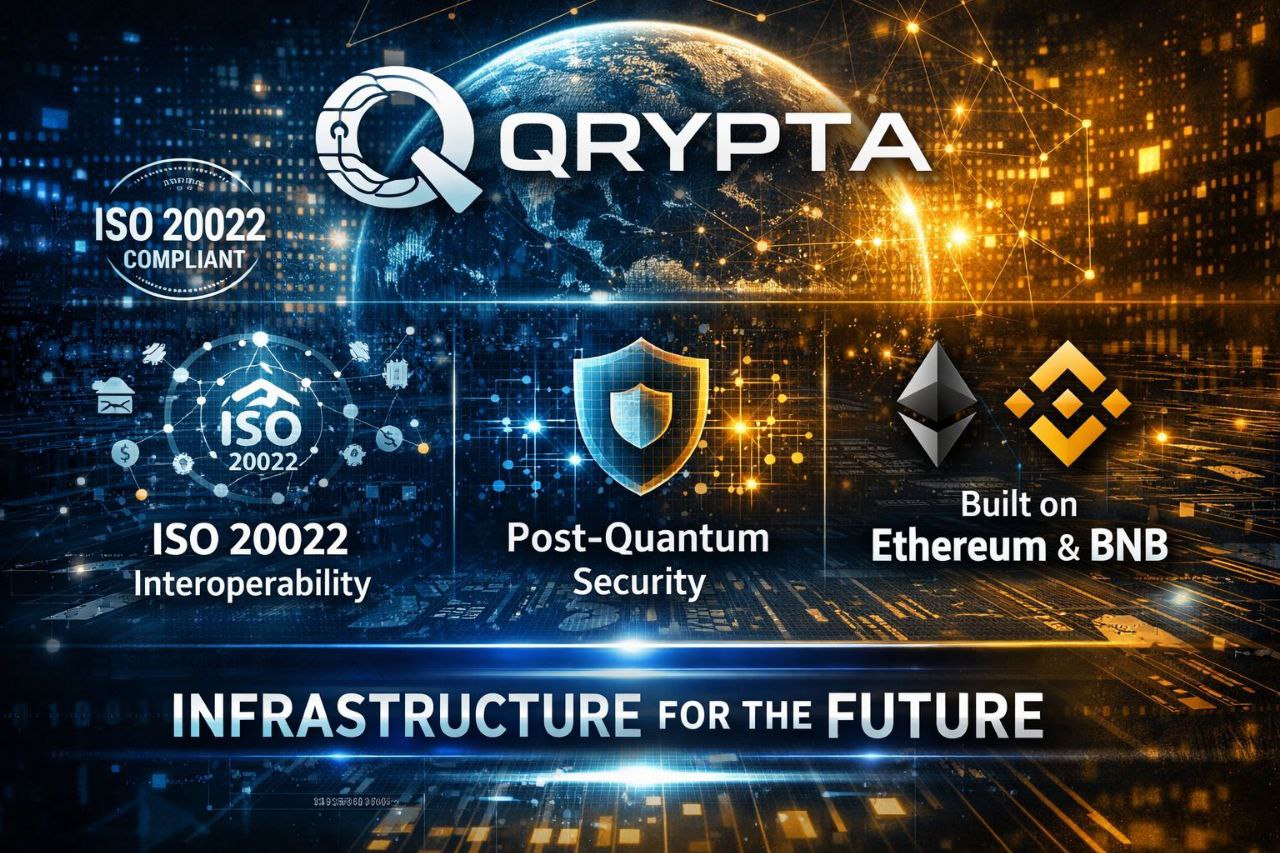
1. What is QRYPTA and what problems do we solve?
Currently, the crypto world faces two major threats: complexity (hard to use for the average user) and quantum vulnerability (future computers will break current wallet security). Provident Quantum Tech was born to solve this by creating a "secure bridge":
Future Insecurity:
We implement Post-Quantum Cryptography (PQC). It's like replacing a wooden lock with reinforced steel that not even the most powerful future computers can open.
Entry Barriers:
We eliminate the need to be a technical expert thanks to our Artificial Intelligence integration.
2. The Technical Core: ZK-Rollups on BNB and ETH
To make transactions fast and private, we use Zero-Knowledge (ZK) technology on the Ethereum and BNB Chain networks.
How does it work?
Imagine having to prove you are of legal age without showing your birth date. ZK technology allows the network to validate that a transaction is real and secure without revealing sensitive data.
The result:
Transactions are much cheaper than on the Ethereum mainnet, with the same security, but featuring an extra privacy layer that other projects don't offer.
3. The Wallet: Your Intelligent Command Center
The Qrypta Wallet is not just a place to store money; it's a personal assistant.
The AI Agent:
Lives inside the wallet and listens to you. You can ask it to move funds, summarize daily news, or analyze if a project is a scam or a real opportunity.
Autotrading Module:
An AI-operated bot working 24/7. While you sleep, the bot analyzes the market and executes strategies to protect your capital or grab yield, something previously done only by large banks.
4. Why are we so INNOVATIVE?
Unlike other projects focusing on just one network (like only ETH or BNB), we are Multichain and Quantum-Ready.
Vs. ETH/BNB: Compared to ETH/BNB: While they are the "highways", we are the "intelligent armored vehicle" traveling on them. We are one of the few projects globally combining AI + ZK + Quantum Resistance in a single, simple application.
5. Positioning and Future (Where are we heading?)
Although a growing company, technologically we are in the Top Tier of Security Innovation. We are being watched by international investors (like those in Costa Rica) as one of the most promising startups in Web3 infrastructure.
Our goal is to become the security standard for asset custody. We aim to be the infrastructure used not only by everyday users but also by institutions needing to protect their information for the next 50 years.
"QRYPTA is like having a private bank in your pocket that is impossible to hack (even by quantum computers) and comes with an expert financial advisor (AI) doing all the hard work for you."
QRYPTA® token & contracts
Official addresses, contract parameters and where to verify them. Any other address is fake.
- Token contract
- 0x5266fe1aD9B035d0ED6142f1A70e9D6F102c8153↗
- Staking contract
- 0xCa52c2603e53A24da10926a90D3BE19EAA6aA40b↗
- Locker (PinkLock v2)
- 0x407993575c91ce7643a4d4cCACc9A98c36eE1BBE↗
- PancakeSwap v3 pool (QRYP/WBNB)
- 0x8b754851f642d4550989f8cfffeb620de8e1ee2c↗
- Max supply
- 1,000,000,000 QRYP · no mint function
- Decimals
- 18
- Burn per transfer
- 0.1 % (burnRateBps = 10) · permanent, reduces the on-chain total supply
- Audit
- CertiK Skynet · 0 critical · 0 major · 0 medium · 0 minor · KYC Silver
- Listings
- PancakeSwap v3 · GeckoTerminal · DexScreener · BNB DappBay
How to buy QRYP
- Install an EVM wallet (QRYPTA Wallet, MetaMask, Trust) and add the BNB Smart Chain network.
- Hold BNB for gas and USDT or BNB to swap.
- Open PancakeSwap and paste the exact token contract above; check the symbol is QRYP.pancakeswap.finance ↗
- Set slippage to 1–2 % (the 0.1 % burn applies on every transfer).
- Add the token to your wallet with the “Add QRYP to wallet” button on/staking.
Staking & referrals
How terms, multipliers, reward claims and the referral contract work.
QryptaYieldStaking contract rules
- •Balance-difference accounting: the contract records exactly the QRYP received after the 0.1 % burn.
- •Rewards accrue per second according to rewardRate and each position's weight (amount × multiplier).
- •Rewards can be claimed every 30 days; principal is withdrawn when the term ends.
- •Displayed APR is visually capped at > 1,000 %; daily yield is computed live from the chain.
- •Non-custodial: only your wallet can withdraw your position. The owner only funds the pool and sets rewardRate.
Ambassador program (QryptaStakingReferralV2)
- Ambassador minimum
- 150 QRYP staked
- Referee minimum per position
- 100 QRYP
- Activation bonus (ambassador)
- 3 / 4 / 6 / 8 % of the stake by rank · 50 % instant + 50 % after 30 days if the referral stays · cap 5,000 QRYP
- Welcome bonus (referee)
- 1 % (100 bps)
- Monthly residual (ambassador)
- 5 % of every staking reward the referral claims · 8 % with a ≥ 6-month streak · cap 2,000 QRYP per claim
- Compounding bonus
- +2 % on the re-staked amount when re-staking ≥ 50 % of the claim within 7 days (registerCompound)
- Ranks
- Bronze 0+ · Silver 5+ & 500 QRYP · Gold 15+ & 1,500 QRYP · Diamond 30+ & 4,000 QRYP (qualified referrals + own stake)
- Streak
- Months without reducing own stake · 12 months = permanent Founder badge
- Profile
- profileOf(user): rank, badge, progress and earnings · TierReached event
- Binding
- Link ?ref=0x… → bind(referrer) once, on-chain
When a reward is pending, the staking page shows a “You have a pending reward” alert with the claim button.Go to staking →
The algorithms behind QRYPTA®.
No proprietary ciphers, no security through obscurity. Every primitive in the stack is a published, peer-reviewed standard — chosen for the exact role it plays, with a documented migration path if it ever needs replacing.
ML-DSA-44
NIST level 2Module-lattice signatures are the NIST primary recommendation for post-quantum signing. Level 2 keeps public keys and signatures small enough for mobile wallets and on-chain anchoring while remaining secure against Shor's algorithm. The signature is generated off-chain and never verified with heavy logic in Solidity.
ZK-STARK
Post-quantum · no trusted setupSTARKs rely only on collision-resistant hashes — no elliptic-curve pairings and no ceremony whose toxic waste could be leaked. The proof states that a valid ML-DSA-44 signature exists over the exact transfer (amount, recipient, nonce, chain domain, deadline) without exposing anything else. The EVM contract verifies the proof and executes.
ML-KEM-768
NIST level 3Protects validator and gossip traffic from harvest-now-decrypt-later: an adversary recording encrypted traffic today cannot open it with a future quantum computer. Sessions rotate keys per epoch.
SLH-DSA
Conservative · hash-only assumptionFor the few keys that must survive a century — genesis, protocol upgrade authority, crypto-suite migration — NEUROCHAIN pairs ML-DSA with SLH-DSA. If lattice assumptions ever weaken, the hash-based signature still holds. Two independent mathematical foundations, one authority.
ChaCha20-Poly1305 + AES-256-GCM
256-bit symmetricThe wallet's .qrypta recovery pack is encrypted twice, with two independent AEAD ciphers from two different design families. Keys are derived with PBKDF2-SHA512 at 80,000 iterations from your master password; a compromised device image is useless without it.
Secure hardware · 2-of-2
Fail-closedThe seed produces only one of the two required signatures. The second key never leaves the phone's secure hardware and is released only after biometrics and master password. On BTC, SOL and TRON the Guardian server co-signs with an enrolled device key, TOTP and a time-lock for large amounts.
Hashing & integrity: SHA-256 / Keccak-256 on-chain, SHA-512 in key derivation, ISO 20022 references hashed and anchored on-chain while the sensitive payload stays encrypted off-ledger.
Why the clock matters
- Aug 2024
NIST publishes FIPS 203 / 204 / 205 — the first post-quantum standards. QRYPTA® builds on exactly these three.
- 2030 → 2035
NIST IR 8547 sets the path to deprecate 112-bit classical schemes (ECDSA, RSA-2048) by 2030 and disallow them by 2035.
- Today
"Harvest now, decrypt later": traffic and keys recorded today can be opened by a future quantum computer. Only data protected post-quantum now stays safe.
- Mainnet
QRYPTA® is not a testnet demo: the PQC transfer contract with ZK verification, the burn token and the staking contracts are live on BNB Chain.
One cryptographic foundation. Four products.
Everything Provident Quantum Tech ships — the QRYPTA® token, the wallet, on-chain staking and the NEUROCHAIN Layer 1 — is built on the same principle: post-quantum authority verified with Zero-Knowledge proofs, and ISO 20022 semantics for real-world finance.
QRYPTA® token
BEP-20 / ERC-20 on BNB Chain and Ethereum with a 0.1% burn on every transfer. Each PQC transfer is signed off-chain with ML-DSA-44 (NIST FIPS 204), compressed into a ZK-STARK proof and verified on-chain with nonce, domain and deadline. ISO 20022 references anchored on-chain for traceability.
- ML-DSA-44 · FIPS 204
- ZK-STARK · no trusted setup
- BNB Chain + Ethereum
- 0.1% burn
- ISO 20022 refs
- CertiK audited
QRYPTA Wallet
Non-custodial wallet for BNB, ETH, BTC, SOL and TRON. ERC-4337 smart account with 2-of-2 signing: the seed alone is never enough — the second factor lives in the phone's secure hardware behind biometrics. Guardian split for non-EVM chains, encrypted recovery pack, per-action security matrix and a hardened Web3 browser.
- ERC-4337 · 2-of-2
- Guardian split BTC/SOL/TRON
- ChaCha20-Poly1305 + AES-256-GCM
- PBKDF2-SHA512 · 80k
- 0x · Jupiter · LI.FI
- LUMI AI copilot
NEUROCHAIN
A cognitive, post-quantum Layer 1 designed from Genesis around six capabilities: NIST PQC (ML-DSA, ML-KEM, SLH-DSA) with crypto-agility, NeuroPoS admission + NeuroBFT deterministic finality, NeuroVM parallel execution, NeuroDAG data plane, native ISO 20022 layer and NeuroImmune self-defense. Engineering target: 200K SFTPS.
- PQC from Genesis
- NeuroBFT + NeuroPoS
- NeuroVM · parallel lanes
- NeuroISO · ISO 20022
- NeuroAI attestations
- NeuroImmune rollback
Staking & referrals
Audited Solidity 0.8.28 + OpenZeppelin 5 contracts on BNB Chain. Yield staking with 90 / 180 / 240-day terms (×1 · ×1.3 · ×1.6), balance-difference accounting compatible with the burn-on-transfer token, 30-day claim cadence and an on-chain referral contract that pays both sides.
- Solidity 0.8.28 · OZ 5
- 90 / 180 / 240 d
- ×1 · ×1.3 · ×1.6
- Fee-on-transfer safe
- On-chain referrals
- Non-custodial
Specification sheet
- Digital signatures
- ML-DSA-44 (Dilithium2, NIST FIPS 204) · classical ECDSA kept only as compatibility alias
- Proof system
- ZK-STARK — transparent, hash-based, post-quantum; verified on the EVM
- Networks (today)
- BNB Chain · Ethereum · Base · Core · Polygon · Arbitrum (EVM) · Bitcoin · Solana · Tron
- Account model
- ERC-4337 smart account, 2-of-2 device-bound signing, gas abstraction
- Encryption at rest
- ChaCha20-Poly1305 + AES-256-GCM cascade · PBKDF2-SHA512, 80,000 iterations
- Key exchange (NEUROCHAIN)
- ML-KEM node-to-node sessions · ML-DSA + SLH-DSA for critical roots
- Consensus (NEUROCHAIN)
- NeuroPoS admission · NeuroBFT deterministic finality · multi-client
- Financial semantics
- ISO 20022 references, hashes and settlement evidence on-chain; sensitive payload off-chain
- Audit & verification
- CertiK Skynet: 0 critical / 0 major / 0 medium / 0 minor · team KYC Silver · BNB DappBay listed
Defense in depth
- 1Identity— Post-quantum ML-DSA-44 identity registered on-chain
- 2Transaction— ZK proof + nonce / domain / deadline; no blind signing
- 3Device— Second key in secure hardware, biometrics + master password
- 4Recovery— Encrypted pack, printable PDF, restricted spending after restore
- 5Network— NeuroShield crypto-agility: governed migration of suites
- 6Assistant— LUMI prepares, never signs — the human decides
NEUROCHAIN · A cognitive, post-quantum, financial, scalable and evolutionary Layer 1.
Not a collection of features but a single L1 designed around six simultaneous capabilities: post-quantum security, native AI in validators, high throughput, permissionless decentralization, ISO 20022 financial semantics and continuous self-defense.
Designed together from Genesis.
Post-quantum security and crypto-agility: ML-DSA, ML-KEM and SLH-DSA, governed migration between suites.
A NeuroAgent inside every validator: analysis, signed attestations and defense. Never the arbiter of consensus.
Secure Finalized Transactions Per Second: validated, executed, committed and finalized. Not raw TPS.
Permissionless Proof of Stake for admission, NeuroBFT for deterministic finality, multi-client by design.
Native, private financial layer: semantics, hashes, references and settlement evidence on-chain; sensitive payload off-chain.
Detect, learn, upgrade and roll back without downtime. Software rollback, never rollback of finalized blocks.
Everything native. Nothing unnecessarily synchronous.
Data, execution, consensus, intelligence and security planes are separated. Cryptographic validation, ordering, execution and finality form the hot path; deep AI analysis, telemetry, indexing, ISO logic and upgrade simulations run in parallel.
- NeuroISOISO 20022 · references · privacy · settlement
- NeuroAINeuroAgents · attestation · risk & anomaly intelligence
- NeuroVMParallel execution · conflict scheduling · lanes
- NeuroBFT + NeuroPoSValidator selection · committees · finality
- NeuroDAG / Data PlaneParallel dissemination · batching · availability
- NeuroShieldML-DSA · ML-KEM · SLH-DSA · crypto-agility
The rules no optimization may contradict.
From one workstation to a permissionless mainnet.
- LAB-014 local validators + AI + explorer + benchmark. Genesis, PQ accounts, Block #0.USD 10K–50K
- DEVNET20+ nodes across regions, wallet integrations, SDK, EVM adapter.USD 250K–750K
- PUBLIC TESTNET50–500 validators, tNEURO faucet, staking, audits, WAN load.USD 1M–2M
- PERF TESTNETAdversarial testing, multi-client, reproducible benchmarks.
- MAINNETProduction infra, formal verification, institutional integrations. Permissionless.USD 3M–7M
Milestone-based funding: the lab proves the core, the devnet proves distribution, the testnet proves adversarial resilience, audits and benchmarks unlock mainnet capital. Ranges are planning estimates, not quotes.
See the full NEUROCHAIN page →Roadmap & company
Completed phases, current phase and upcoming milestones. Legal data of Provident Quantum Tech S.R.L.
Contracts deployed · post-quantum rail live · ZK verification
QRYPTA Wallet beta · self-custody · multichain
CertiK Skynet audit · 0 findings · KYC Silver
QRYP live on PancakeSwap · 0.1 % burn · DappBay · GeckoTerminal
Staking & governance
On-chain yield staking (90 / 180 / 240 days) is live. Referral contract, reward pool funding and the first governance parameters are being rolled out.
- 06Wallet audit
Full external audit of the QRYPTA Wallet: PQC core, 2-of-2 smart account, Guardian and recovery pack.
- 07QRYP services inside the wallet
Native QRYP utilities in-app: fee discounts, card staking, swap routing and LUMI-assisted payments.
- 08Marketing expansion
Global campaigns, KOLs, hackathons and institutional PR positioning QRYPTA® as the post-quantum standard.
- 09QRYPTA Exchange
Launch of the exchange with QRYP as the settlement asset and post-quantum custody.
- 10Neobank integration · Qatar
ISO 20022 rails connecting the wallet and QRYP to the Qatar neobank for fiat on/off-ramps.
- 11NEUROCHAIN testnet
Public testnet: tNEURO faucet, validators, PQC accounts and the EVM adapter.
- 12Public testing
Adversarial testing, multi-client runs, independent benchmarks and audits before mainnet.
- 13NEUROCHAIN mainnet
Permissionless Layer 1 — post-quantum from Genesis, NeuroBFT finality, native ISO 20022.
Order is the commitment; dates are announced only through official channels once each milestone is verified.
Company & trademark
- Legal name
- PROVIDENT QUANTUM TECH S.R.L.
- Corporate ID
- 3-102-965820 · Costa Rica
- Headquarters
- San José, Costa Rica
- Registered trademark
- QRYPTA® · National Registry of Costa Rica No. 419244 · classes 9, 36 & 42 · valid until 2036
- Official channels
- providentquantum.tech · x.com/QRYPTARail
- Audit
- CertiK Skynet · KYC Silver
QRYPTA® 是在哥斯达黎加国家登记处知识产权登记局注册的组合商标(注册号 419244,第 9、36 和 42 类,有效期至 2036 年)。未经 PROVIDENT QUANTUM TECH S.R.L.(法人编号 3-102-965820)事先明确的书面授权,明令禁止对其标志、品牌标识、名称、字体、视觉形象、图片、设计、卡片、品牌素材、源代码或任何其他资产进行全部或部分的复制、拷贝、模仿、修改、分发、公开传播或商业使用。
任何侵权行为都将依据哥斯达黎加《商标及其他显著性标志法》第 7978 号、《知识产权执法程序法》第 8039 号、《著作权及邻接权法》第 6683 号以及适用的国际条约(《巴黎公约》、TRIPS)追究一切民事、行政和刑事责任,包括损害赔偿诉讼、禁令救济、没收侵权材料,以及向主管机关和平台(交易所、应用商店、域名注册商和社交网络)举报。
QRYPTA® 为注册商标(哥斯达黎加国家登记处,注册号 419244)。任何未经授权复制标志、品牌素材或内容的行为均将受到法律追究。